

Your Instagram bio is your professional handshake in the digital world. As an electrical engineer, you have 150 characters to communicate your expertise, specialization, and personality while encouraging profile visitors to follow, connect, or explore your work.
This comprehensive guide provides 250+ ready-to-use bio examples organized by career stage, specialization, and tone — plus expert formatting tips, emoji strategies, and practical advice for building a strong Instagram presence in 2026.
Instagram Bio Generator
Create a stunning bio in seconds with AI
Professional Electrical Engineer Bio Examples
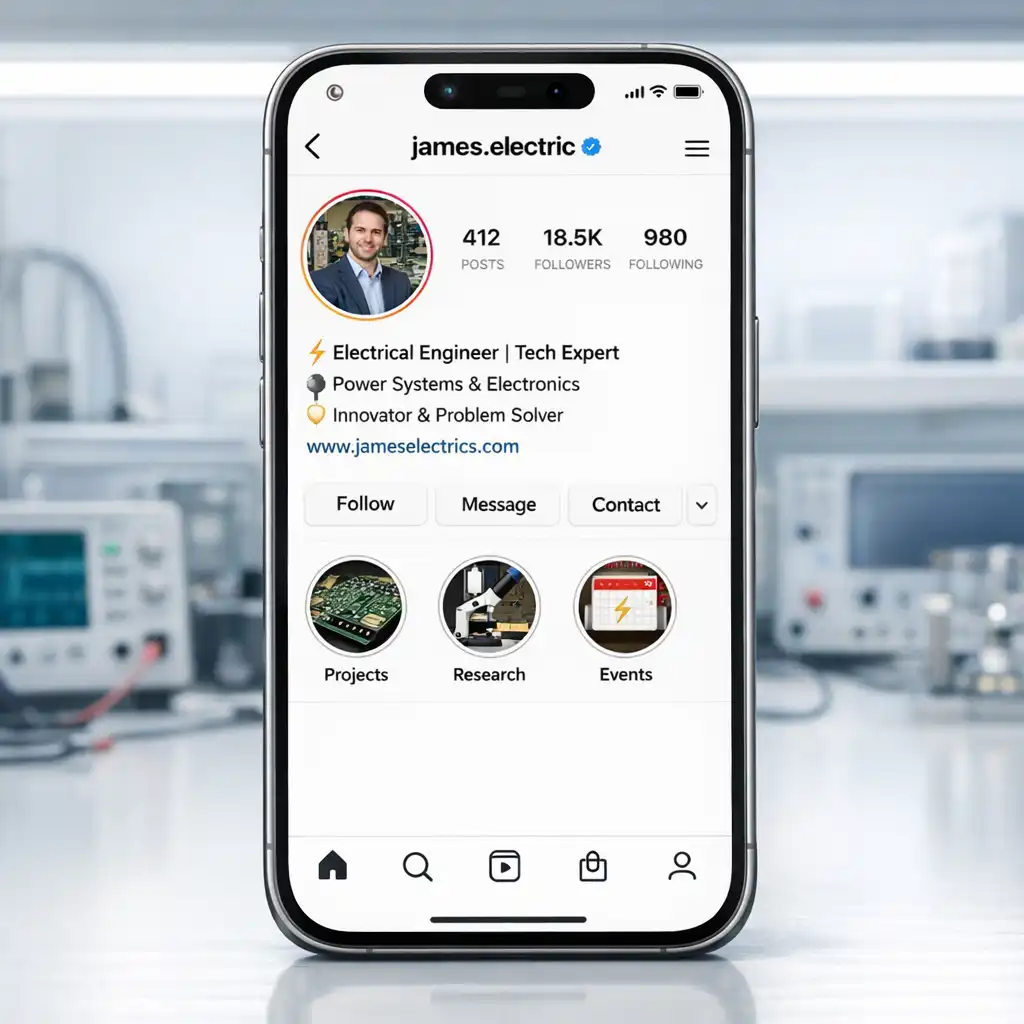
Professional bios emphasize credentials, specialization, and industry authority. These work best for experienced engineers seeking industry connections, job opportunities, consulting clients, or speaking engagements.
| Bio Example | Why It Works | Best For |
|---|---|---|
| Senior Electrical Engineer @TeslaEnergy ⚡ Power systems & renewable integration IEEE Senior Member | 15+ patents |
Strong institutional affiliation + quantifiable achievements establish immediate credibility | Senior engineers, industry veterans |
| RF Engineer | Antenna Design Specialist 📡 @QualcommInc | PhD @Stanford 5G • IoT • Wireless Innovation |
Clear niche specialization with educational pedigree and trending tech keywords | Specialized engineers in cutting-edge fields |
| Power Systems Engineer 🔌 Grid modernization • SCADA • Smart grids Former @Siemens | Consultant | Speaker |
Multiple revenue streams and former employer credibility signal versatility | Independent consultants |
| Embedded Systems Engineer 💻 ARM • RTOS • IoT firmware development Building smarter devices at @TexasInstruments |
Technical stack listing attracts recruiters and collaborators | Firmware and embedded engineers |
| Control Systems Engineer ⚙️ Automation • PLC • Robotics Making factories smarter, one controller at a time |
Conversational tone balances technical expertise with approachability | Automation and robotics engineers |
| Electrical Design Engineer | P.E. Licensed 📐 Commercial & industrial electrical systems 15 years designing safe, efficient buildings |
Professional licensure (P.E.) is major trust signal for potential clients | Licensed professional engineers |
| Signal Processing Engineer 📊 Machine learning for radar & sonar systems @NorthropGrumman | Published researcher |
Combines AI trend with traditional EE specialty, plus publication credibility | Research-focused engineers |
| Power Electronics Engineer 🔋 EV inverters, chargers & battery management Electrifying transportation @RivianOfficial |
Hot industry (EVs) + clear impact statement attracts talent and opportunities | Automotive/EV engineers |
| Electrical Project Manager ⚡ Leading multi-million dollar installations PMP Certified | 20+ successful projects delivered |
Management credentials + quantifiable success metrics | Project managers, team leads |
| High Voltage Engineer 🌩️ Transmission lines, substations & protection systems Keeping the grid reliable 24/7 |
Niche specialty + mission-driven language creates unique positioning | Utility and transmission engineers |
Electrical Engineering Student Bio Ideas
Student bios should highlight your university, year, interests, and what you’re seeking (internships, research opportunities, networking). Show enthusiasm and openness to learning.
| Bio Example | Career Stage |
|---|---|
| EE Student @MIT Class of 2027 ⚡ Passionate about power electronics & renewable energy Seeking summer 2026 internship opportunities |
Undergraduate, early stage |
| Electrical Engineering Junior @GaTech 🐝 Robotics • Control Systems • Embedded Software IEEE Student Member | Looking to collaborate |
Undergraduate, mid-stage |
| EE Senior @UCBerkeley | Graduating May 2026 🎓 VLSI design • Analog circuits • Chip architecture Portfolio & resume in link ↓ |
Undergraduate, final year |
| Master’s Student in Power Systems @Stanford ⚡ Researching grid-scale battery storage GRA @SLAC National Lab |
Graduate student (Master’s) |
| PhD Candidate | RF & Microwave Engineering 📡 @UTAustin | Dissertation: 6G antenna arrays Graduating 2027 |
PhD candidate |
| Electrical Engineering Freshman @Purdue 🚀 Still figuring it all out but loving circuits! Future power systems engineer (maybe) |
Undergraduate, first year |
| EE Student @UIUC | IEEE VP 💡 Organizing hackathons & tech talks Interests: IoT, embedded systems, ML |
Student leader |
| Double Major: EE + Computer Science @CMU 💻⚡ Building the future of edge computing Always open to project collaborations |
Double major student |
| Electrical Engineering Co-op @GeorgiaTech 🔧 Currently interning @NASAJohnson Spacecraft power systems are wild! |
Co-op/intern student |
| Community College EE Transfer Student 🎓 Transferring to UCLA Fall 2026 Proof that every path is valid ✨ |
Transfer student |
Electrical Engineer Bio Examples by Specialization
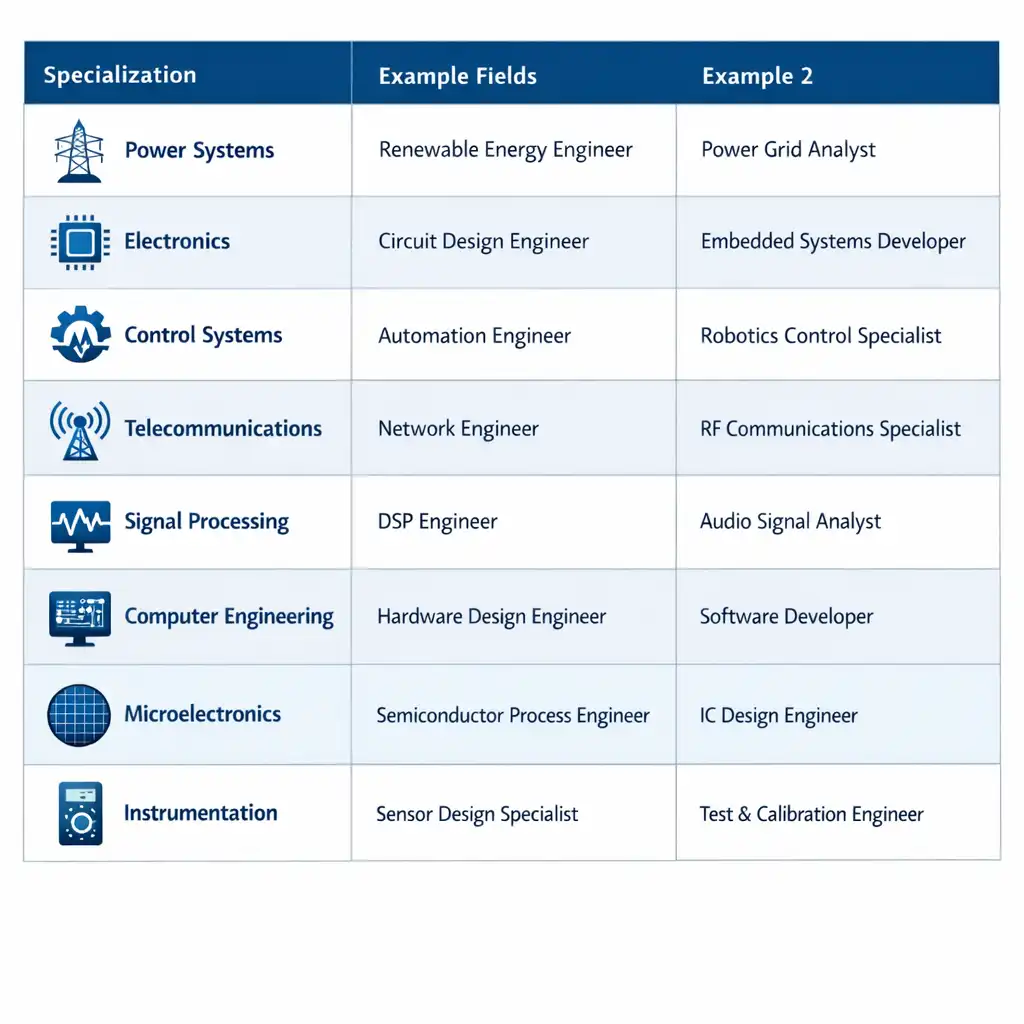
Tailor your bio to your specialty to attract the right audience, collaborators, recruiters, and opportunities.
| Specialization | Bio Example 1 | Bio Example 2 |
|---|---|---|
| Power Systems | Power Systems Engineer ⚡ Grid stability, SCADA & renewable integration @ABB | Making clean energy reliable |
Transmission Planning Engineer 🌩️ Designing the backbone of the electric grid 15 years keeping the lights on |
| Electronics | Analog IC Design Engineer 💡 Low-power circuits for wearable tech @TexasInstruments | 10+ tape-outs |
PCB Design Engineer 🔌 High-speed digital, RF, power electronics Altium wizard | DFM enthusiast |
| Control Systems | Control Systems Engineer ⚙️ PID tuning, model predictive control, automation Making processes smarter & safer |
Robotics Control Engineer 🤖 Motion planning, kinematics, real-time control Building the future, one servo at a time |
| Telecommunications | Telecom Engineer 📡 5G networks, fiber optics, RF planning Connecting the world @Ericsson |
Network Engineer | Wireless Specialist 📶 LTE, 5G NR, mmWave deployment Optimizing coverage & capacity |
| Signal Processing | DSP Engineer 📊 Audio processing, noise cancellation, filters @BoseOfficial | Making sound beautiful |
Radar Engineer | Signal Processing 🛰️ Synthetic aperture radar & target detection Defense tech @Raytheon |
| Embedded Systems | Embedded Software Engineer 💻 C/C++, RTOS, ARM Cortex-M Firmware for medical devices @Medtronic |
IoT Engineer 🌐 Sensors, edge computing, cloud integration Building connected products @AmazonAWS |
| Power Electronics | Power Electronics Engineer 🔋 DC-DC converters, inverters, motor drives Renewable energy systems @SolarEdge |
EV Power Systems Engineer ⚡🚗 Battery management, inverters, chargers Electrifying mobility @Tesla |
| Instrumentation | Instrumentation Engineer 🔧 Sensors, calibration, data acquisition Oil & gas sector @Schlumberger |
Test Engineer | Measurement Specialist 📏 Automated test equipment, validation Ensuring quality @NationalInstruments |
| VLSI/Chip Design | VLSI Design Engineer 🖥️ Digital design, verification, RTL coding Next-gen processors @Intel |
Analog Layout Engineer 📐 Custom IC layout, parasitic extraction Silicon art @AnalogDevices |
| Lighting Design | Lighting Design Engineer 💡 LED systems, smart lighting, energy efficiency Illuminating spaces @Philips |
Architectural Lighting Engineer ✨ Designing ambiance with precision Art meets engineering |
| Renewable Energy | Renewable Energy Engineer 🌱 Solar PV, wind, grid integration Powering the green transition |
Energy Storage Engineer 🔋 Battery systems, microgrids, demand response Building resilient energy infrastructure |
| Electromagnetic | EMC Engineer ⚡ EMI/EMC testing, compliance, troubleshooting Making products safer & compliant |
Antenna Engineer 📡 RF design, radiation patterns, simulation Wireless communication @Apple |
Funny Electrical Engineer Bios
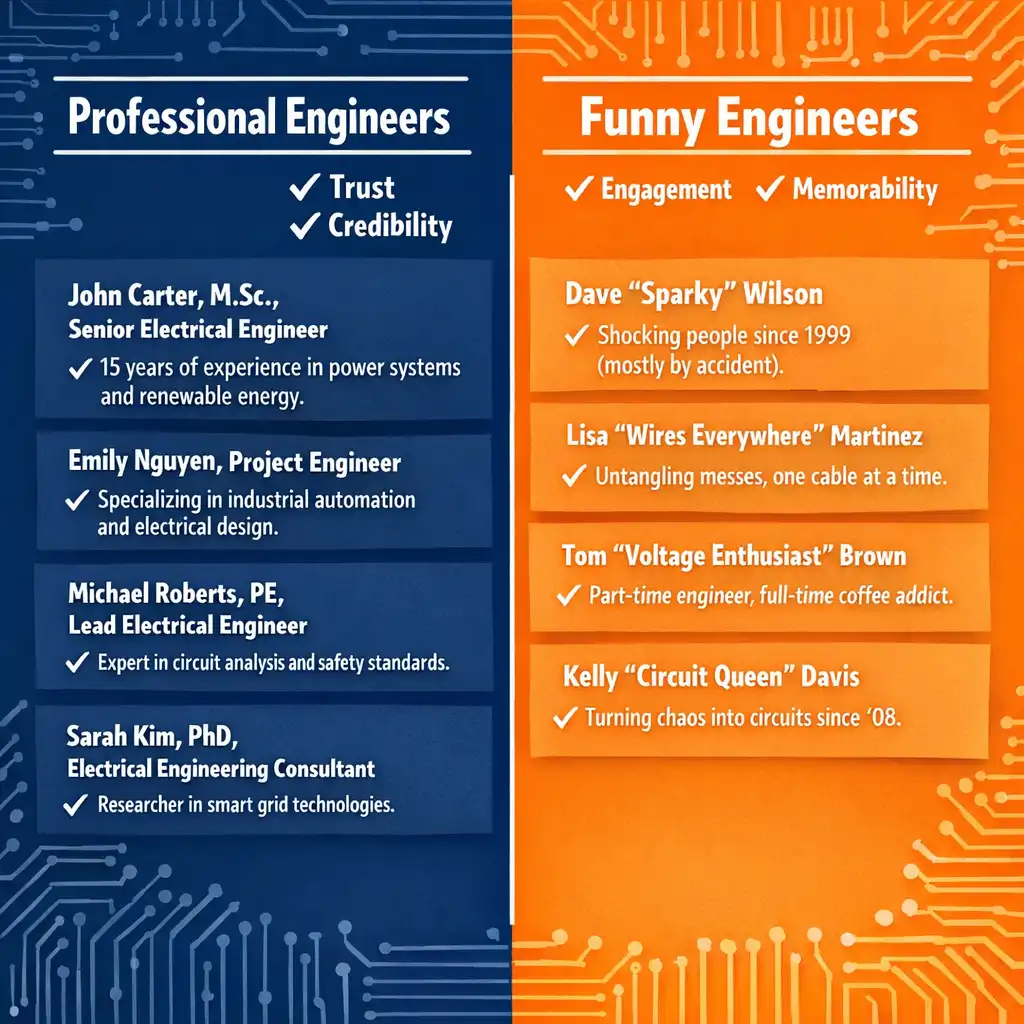
Humor makes you memorable and approachable. These bios work well for content creators, educators, or engineers who want to stand out and build a personal brand.
| Bio Example | Humor Style |
|---|---|
| Electrical Engineer ⚡ I’m currently resisting the urge to make more puns. Ohm my god, here we go again. |
Pun-based |
| EE by day. Debugger by night. 🐛 My code has more bugs than features. Send coffee and datasheets. |
Relatable self-deprecation |
| Electrical Engineer 💡 I solve problems you didn’t know you had in ways you don’t understand. |
Ironic expertise |
| Professional circuit breaker. Literally. ⚡ Also: amateur plant killer 🌱 Good with electrons, bad with chlorophyll. |
Humanizing contrast |
| Electrical Engineer who still Googles Ohm’s Law. 15 years experience. Still learning. Mostly Googling. |
Honest self-awareness |
| I’m an electrical engineer. I find your lack of grounding disturbing. ⚡ (Star Wars + safety puns = my brand) |
Pop culture + technical |
| Turning coffee into circuits since 2015 ☕⚡ Efficiency: 37% on good days Debugging skills: questionable |
Relatable struggle |
| Electrical Engineer | Professional overthinker 🧠 Will analyze the circuit in your toaster. I’m fun at parties. Really. |
Nerdy self-mockery |
| I’m shocked you’re still reading this. ⚡😂 Electrical Engineer with a current sense of humor. Watt more do you need? |
Layered wordplay |
| Electrical Engineer 💡 My jokes are like my circuits: grounded. Also: I’m positively charged today. |
Double-meaning puns |
| Senior Engineer. Junior cook. 🍳⚡ Can design a power supply. Can’t boil water. Balance, right? |
Life skill contrast |
| Electrical Engineer who peaked in college. Still riding that one project presentation. 🎓 Graduated 2019. Still talking about it. |
Nostalgic humor |
| I’m like a capacitor: I store potential. 🔋 Electrical Engineer | Aspiring functioning adult One of these is going well. |
Self-deprecating analogy |
| Electrical Engineer ⚡ Resistance is futile. Actually, it’s 10kΩ. I’ll see myself out. |
Physics pun + self-awareness |
| Professional wire untangler. 🔌 Amateur life organizer. 🗂️ One of these I’m actually good at. |
Professional vs personal contrast |
Electrical Engineer Bios for Different Career Stages
Your bio should evolve with your career. Here are examples tailored to specific career milestones.
| Career Stage | Bio Example |
|---|---|
| Recent Graduate | Electrical Engineer | Class of 2026 🎓 Power systems focus | EIT certified Ready to make an impact ⚡ |
| Entry-Level (0-2 years) | Junior Electrical Engineer @GeneralElectric ⚡ Learning every day | Power distribution EIT working toward P.E. license |
| Mid-Level (3-7 years) | Electrical Engineer @Schneider Electric 🔌 5 years in building automation & controls LEED AP | Energy efficiency advocate |
| Senior (8-15 years) | Senior Electrical Engineer | P.E. Licensed ⚡ 12 years designing critical infrastructure Mentor | Speaker | Problem solver |
| Lead/Principal (15+ years) | Principal Electrical Engineer @SiemensEnergy 20+ years | 50+ power plants designed Leading the next generation of grid tech 🌐 |
| Manager/Director | Director of Electrical Engineering @Honeywell 🏢 Leading a team of 30+ engineers Building products that matter |
| Consultant | Independent Electrical Consultant ⚡ 15 years | P.E. | Specializing in industrial power Helping clients solve complex problems |
| Entrepreneur | Founder @SmartGridSolutions 🚀 Electrical Engineer turned entrepreneur Building the future of energy tech |
| Researcher/Academic | Assistant Professor of Electrical Engineering 🎓 @StanfordEE | Researching wireless power transfer Published in IEEE, Nature Energy |
| Retired/Emeritus | Retired Electrical Engineer ⚡ 40 years in power systems | Still learning Mentoring the next generation |
Instagram Bios for Electrical Engineering Content Creators
If you create educational content, tutorials, or engineering entertainment, your bio should emphasize your value to followers.
| Content Type | Bio Example |
|---|---|
| YouTube Educator | Electrical Engineer | YouTube Educator 📹 500K subs | Making circuits simple New tutorial every Tuesday ↓ |
| TikTok Explainer | EE Prof explaining circuits in 60 seconds ⚡ 2M followers on TikTok 📱 Engineering made fun (and accurate) |
| Instagram Educator | Daily electrical engineering tips ⚡💡 Helping students ace their EE exams Free study guides in link ↓ |
| Podcast Host | Host of “The Circuit Podcast” 🎙️ Interviewing top electrical engineers weekly Listen on Spotify, Apple Podcasts ↓ |
| Newsletter Writer | Electrical Engineer | Weekly Newsletter 📧 Power systems insights for 10K+ subscribers Subscribe for free ↓ |
| Project Showcase | Building cool electronics projects ⚡🔧 Arduino • Raspberry Pi • Custom PCBs New build every week | Tutorials in bio ↓ |
| Meme Account | Electrical Engineering Memes ⚡😂 Because engineers need to laugh too Tag your EE friends | DMs open for submissions |
| Career Coach | Helping EE students land dream jobs 🎯 Resume tips | Interview prep | Career advice Free resources in link ↓ |
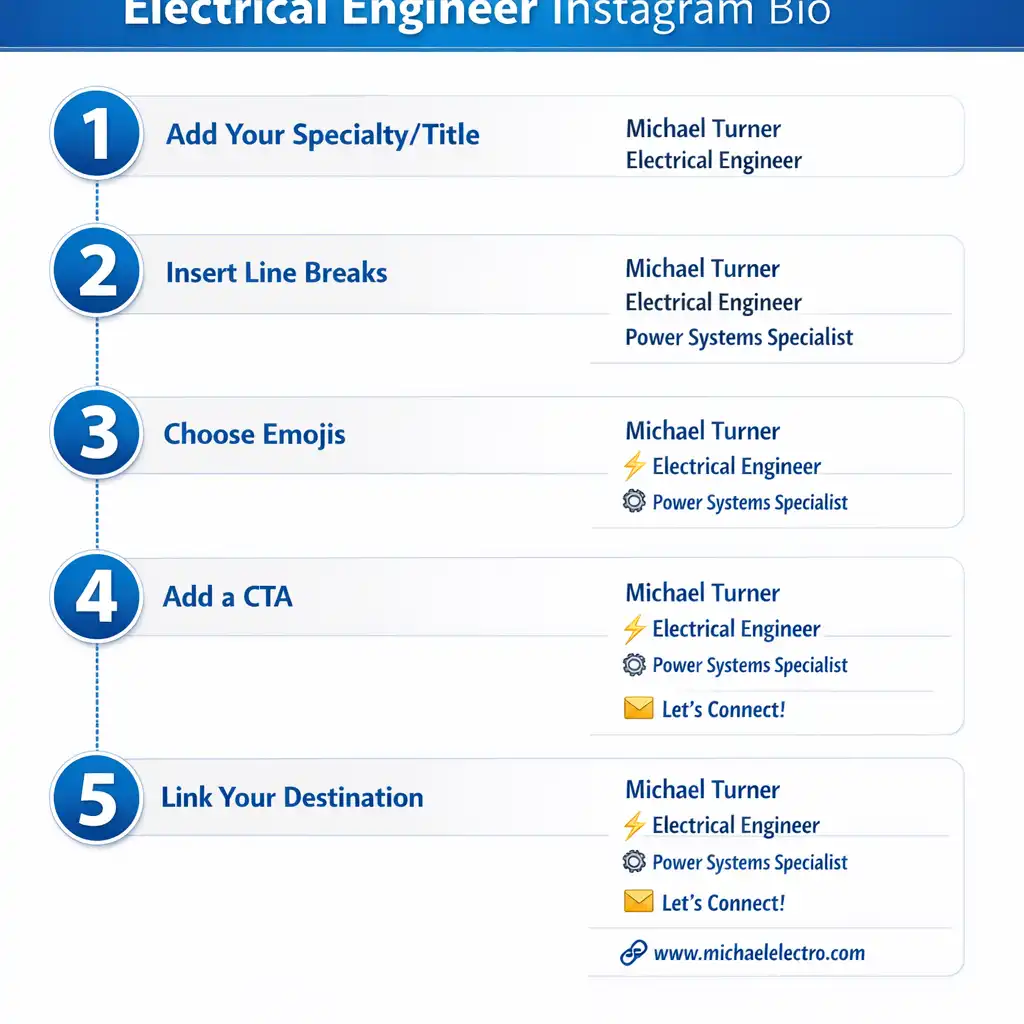
How to Format Your Electrical Engineer Instagram Bio
Great content needs great formatting. Follow these proven strategies to make your bio scannable and effective.
Use Line Breaks for Visual Clarity
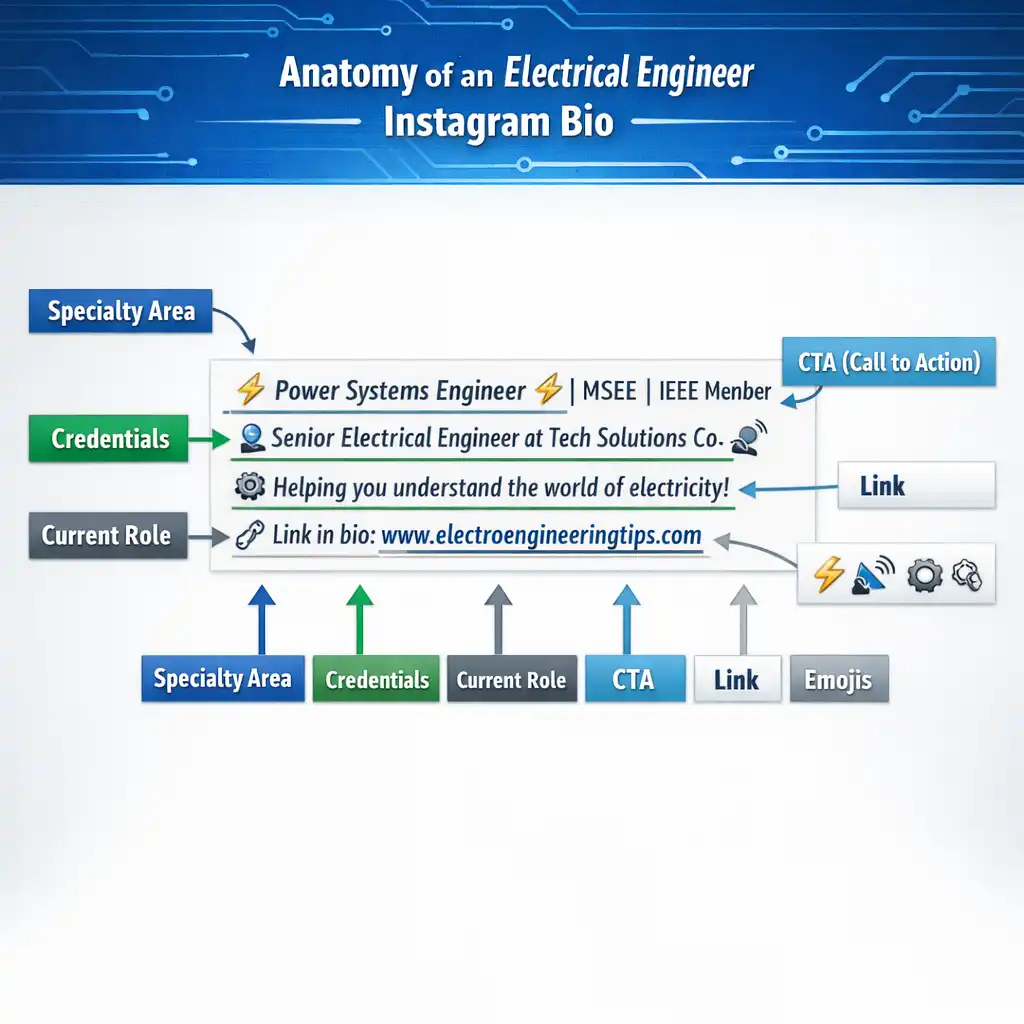
Break your bio into 2–4 short lines. Each line should communicate one distinct idea. Use the return key or special characters (•, |, —) to create separation.
Recommended structure:
- Line 1: Title + Specialization (e.g., “Power Systems Engineer ⚡”)
- Line 2: Current role, employer, or key credential (e.g., “@Siemens | P.E. Licensed”)
- Line 3: Value proposition or CTA (e.g., “Designing smarter grids | Portfolio ↓”)
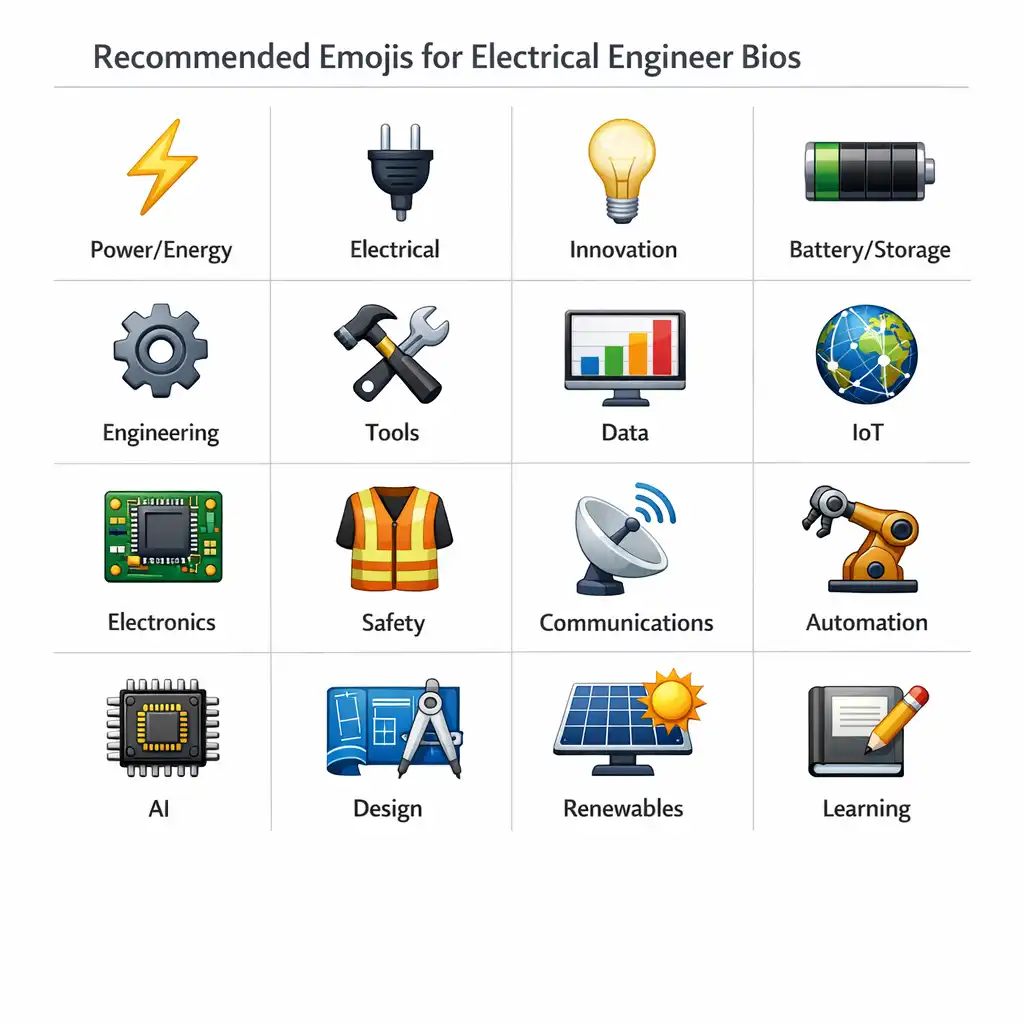
Choose 1–2 Relevant Emojis
Emojis add personality and improve scannability. Choose icons that reinforce your specialty without cluttering your bio.
| Emoji | Meaning / Use Case |
|---|---|
| ⚡ | Power, electricity, energy (most universal) |
| 🔌 | Electrical systems, connections, wiring |
| 💡 | Innovation, ideas, lighting design |
| 🔋 | Battery tech, energy storage, EVs |
| ⚙️ | Engineering, mechanical systems, controls |
| 🛠️ | Hands-on work, troubleshooting, tools |
| 📡 | Telecommunications, RF, antennas, wireless |
| 🌐 | IoT, networks, global reach, connectivity |
| 🤖 | Robotics, automation, AI integration |
| 🔬 | Research, lab work, academic focus |
| 🎓 | Education, student, professor, learning |
| 📊 | Data analysis, signal processing, metrics |
| 💻 | Embedded systems, software, programming |
| 🌱 | Renewable energy, sustainability, green tech |
Emojis to Avoid
- 🚀 (overused, crypto/startup vibe)
- 🔥 (too casual, marketing-heavy)
- 💰💸 (can seem unprofessional or sales-focused)
- 😎🤩 (undermines professional credibility)
Include a Clear Call-to-Action
Tell visitors what to do next. Effective CTAs for electrical engineers:
- “Portfolio in link ↓”
- “DM for project inquiries”
- “Download my free circuit guide ↓”
- “Watch my latest tutorial ↓”
- “Subscribe to my newsletter ↓”
- “Hiring! Apply via link ↓”
- “Check out my GitHub ↓”
Optimize Your Link Destination
| Link Type | Best For |
|---|---|
| Personal website/portfolio | Showcasing projects, resume, contact info |
| LinkedIn profile | Job seekers, professional networking |
| GitHub repository | Embedded/software engineers, open-source contributors |
| YouTube channel | Video content creators, educators |
| Link-in-bio tool (Linktree, etc.) | Multiple destinations (portfolio, blog, shop, etc.) |
| Newsletter signup page | Building subscriber list, thought leadership |
| Online course/product | Monetizing expertise, education products |
| Job application portal | Recruiters, hiring managers |
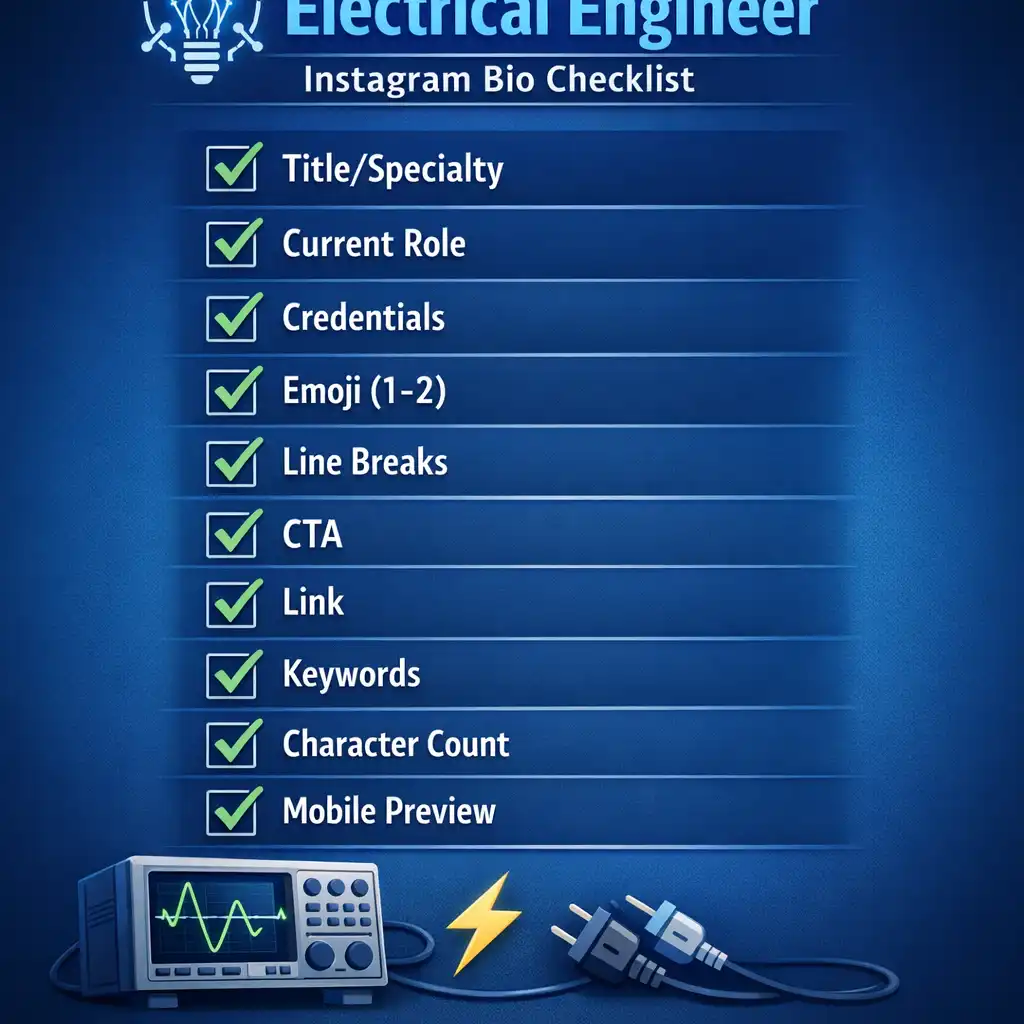
Stay Under 150 Characters
Instagram bios max out at 150 characters. Aim for 110–140 to ensure full visibility in previews and search results.
Use Keywords Strategically
Include searchable terms your target audience might use:
- Electrical Engineer
- Power Systems
- Embedded Systems
- Control Systems
- RF Engineer
- Electronics
- Renewable Energy
- IoT
- VLSI
Best Emojis for Electrical Engineers
Choosing the right emoji can instantly communicate your specialty and add visual interest without cluttering your bio.
Top Recommendations by Specialty
| Specialty | Best Emoji | Example Usage |
|---|---|---|
| Power Systems | ⚡🔌 | “Power Systems Engineer ⚡” |
| Embedded Systems | 💻🔧 | “Embedded Engineer 💻” |
| RF/Telecommunications | 📡📶 | “RF Engineer 📡” |
| Renewable Energy | 🌱⚡ | “Renewable Energy Engineer 🌱” |
| Robotics/Automation | 🤖⚙️ | “Robotics Engineer 🤖” |
| Electronics/PCB Design | 🔌🛠️ | “PCB Designer 🔌” |
| Lighting Design | 💡✨ | “Lighting Engineer 💡” |
| IoT | 🌐📡 | “IoT Engineer 🌐” |
| EV/Battery Tech | 🔋⚡ | “EV Power Systems Engineer 🔋” |
| Research/Academic | 🔬🎓 | “EE Researcher 🔬” |
Common Mistakes to Avoid in Electrical Engineer Bios
| Mistake | Why It’s Bad | Fix |
|---|---|---|
| Too generic (“Electrical Engineer”) | Doesn’t differentiate you from thousands of others | Add specialty: “Power Systems Engineer” or “Embedded Systems Specialist” |
| No specialization mentioned | Missed opportunity to attract niche opportunities | State your focus: controls, RF, power electronics, etc. |
| Wall of text with no line breaks | Hard to read on mobile, looks unprofessional | Break into 2–4 short, scannable lines |
| Too many emojis (5+) | Looks cluttered and unprofessional | Stick to 1–2 relevant emojis |
| No call-to-action | Visitors don’t know what to do next | Add CTA: “Portfolio ↓” or “DM for inquiries” |
| Outdated credentials | Signals inactive or stale profile | Update bio every 6 months with current role/projects |
| Jargon overload | Alienates non-technical visitors | Balance technical terms with accessible language |
| No link or broken link | Wastes Instagram’s one clickable link opportunity | Always include working link to portfolio, LinkedIn, or key resource |
| Clichés like “passionate” or “innovative” | Sounds generic and AI-written | Show, don’t tell: “15 patents” > “innovative engineer” |
Advanced Tips: Optimizing Your Electrical Engineer Bio for 2026
Leverage Instagram’s Name Field
Your “Name” field (separate from username) is searchable. Use it strategically:
- Example: “John Smith | Electrical Engineer”
- This helps you appear when users search “electrical engineer” on Instagram
Update Your Bio Seasonally
Refresh your bio when you:
- Change jobs or get promoted
- Earn a new certification (P.E., PMP, etc.)
- Launch a product, course, or service
- Publish research or earn a patent
- Hit a follower milestone
- Start a new major project
A/B Test Different Versions
Try different bio formats every 4–6 weeks and track:
- Profile visit-to-follow conversion rate
- Link click-through rate
- DM inquiry volume
- Follower growth rate
Use Your Bio to Filter Opportunities
Be specific about what you want:
- “Seeking robotics collaboration opportunities”
- “Open to consulting inquiries”
- “Not currently job seeking”
- “Accepting RA applications for summer 2027”
Include Proof/Social Proof When Possible
- “15+ patents” (quantifiable achievement)
- “Featured in IEEE Spectrum” (media credibility)
- “500K+ YouTube subscribers” (audience size)
- “P.E. Licensed” (professional credential)
Real-World Electrical Engineer Bio Examples (2026)
Here are bio structures modeled on successful electrical engineer profiles in 2026:
| Bio | Why It Works |
|---|---|
| Senior Electrical Engineer @Apple ⚡ Power management for iPhone & Mac 10 patents | MIT alum | Speaker |
Prestigious employer + quantifiable achievements + educational pedigree |
| Electrical Engineer | YouTube Educator 📹 800K subs | Making circuits simple New tutorial every Tuesday ↓ |
Clear value prop, social proof, posting schedule, CTA |
| Power Systems Engineer | P.E. Licensed ⚡ 15 years designing critical infrastructure Consultant | Speaker | DM for inquiries |
Credentials, experience, multiple revenue streams, clear CTA |
| PhD Candidate @Stanford EE 🎓 Researching wireless power transfer Published in Nature Energy | Graduating 2027 |
Academic prestige, high-impact publication, timeline clarity |
| Embedded Systems Engineer 💻 ARM • RTOS • C/C++ • Python Building IoT products @Amazon |
Technical stack listing attracts recruiters and collaborators |
| EV Power Electronics Engineer 🔋 Battery management systems @Rivian Helping electrify transportation |
Hot industry + mission-driven language creates unique positioning |
Electrical Engineer Bio Examples with Emojis
Strategic emoji use can make your bio more engaging without sacrificing professionalism.
| Bio Example | Emoji Strategy |
|---|---|
| Power Systems Engineer ⚡ Grid modernization & renewable integration @Siemens | IEEE Senior Member |
Single emoji reinforces specialty without clutter |
| Electrical Engineer 🔌💡 Lighting design for commercial spaces LEED AP | 20 years brightening buildings |
Two complementary emojis (electrical + lighting) |
| RF Engineer 📡 | PhD @MIT 🎓 5G antenna design for mobile devices Published researcher | Tech enthusiast |
Emojis visually separate key credentials |
| Embedded Engineer 💻 • Maker 🔧 • Dad 👨👧 Building connected devices @Nest Sharing projects & dad jokes |
Multiple emojis with bullet separators create distinct identity pillars |
| EE Student @GaTech 🐝⚡ Power electronics & renewable energy Seeking summer 2026 internship |
School mascot + specialty emoji shows school pride |
Frequently Asked Questions
How long should an electrical engineer’s Instagram bio be?
The ideal length is 110–140 characters out of Instagram’s 150-character maximum. This provides enough space to include your title, specialization, current role or credential, and a brief call-to-action, while ensuring your bio displays fully in search results and profile previews without truncation. Shorter bios (80–100 characters) can work if you have strong name recognition or a very clear niche, but most electrical engineers benefit from using more space to establish credibility and direct visitors toward their portfolio, LinkedIn, or other key resources.
Should I include my P.E. license or certifications in my Instagram bio?
Yes, absolutely — if you hold a Professional Engineer (P.E.) license or relevant certifications like PMP, LEED AP, or Six Sigma, include them. These credentials are major trust signals that differentiate you from unlicensed engineers and can attract consulting clients, job recruiters, and professional opportunities. Place them on your second line after your title and specialty for maximum visibility. For example: “Electrical Engineer | P.E. Licensed” or “Senior EE @Siemens | PMP Certified.” If you’re an EIT (Engineer in Training), mention that as well to show you’re progressing toward full licensure.
What emojis should electrical engineers use in their Instagram bio?
Use 1–2 professional, specialty-relevant emojis. Top choices include: ⚡ (power/electricity — most universal), 🔌 (electrical systems), 💡 (innovation/lighting), 🔋 (battery/energy storage), 📡 (RF/telecom), 💻 (embedded/software), 🤖 (robotics/automation), 🌐 (IoT/networking), ⚙️ (engineering/controls), 🌱 (renewable energy), and 🎓 (academic/student). Avoid overused startup emojis like 🚀, casual emojis like 🔥, or money-focused emojis like 💰, which can undermine professional credibility. The right emoji adds visual interest and helps communicate your focus instantly, especially in search results and profile browsing.
How do I write a funny electrical engineer bio without seeming unprofessional?
Use intelligent, field-specific humor that demonstrates your expertise rather than undermining it. Electrical engineering puns (Ohm’s Law jokes, resistance puns, current wordplay), self-deprecating observations about debugging or documentation, or relatable struggles (turning coffee into circuits, still Googling basic formulas) work well. Avoid humor that makes you seem incompetent, dismissive of safety, or unprofessional. The goal is to be approachable and memorable while still signaling competence. If your primary audience is recruiters or corporate clients, lean more professional; if you’re building a content creator brand or targeting students, humor can be a powerful differentiator.
What should I link to in my electrical engineer Instagram bio?
Link to your highest-value destination based on your primary goal. If you’re job seeking, link to your LinkedIn profile or online portfolio showcasing projects, resume, and technical skills. If you’re a content creator, link to your YouTube channel, blog, or Linktree with multiple destinations. If you’re selling products or services (consulting, courses, templates), link to your sales or booking page. If you’re a researcher, link to your Google Scholar profile or latest publication. If you have multiple priorities, use a link-in-bio tool, but make sure your top priority is the first link visitors see. Update your link regularly to match your current focus.
How often should I update my electrical engineer Instagram bio?
Update your bio every 4–6 months or whenever you have a significant professional change such as a new job, promotion, certification (P.E. license, PMP, etc.), patent, publication, product launch, or major project completion. Regular updates signal that your profile is active and current, which improves follower trust and engagement. Even small tweaks — like refreshing your CTA, updating your link destination, or adding a recent achievement — can meaningfully impact how visitors perceive your profile and whether they choose to follow, click, or reach out. Set a recurring calendar reminder to review your bio quarterly.
Should I mention my electrical engineering specialization in my Instagram bio?
Yes, absolutely. Stating your specialization (power systems, embedded systems, RF, controls, power electronics, VLSI, etc.) immediately communicates your expertise and helps you attract the right audience, collaborators, recruiters, and opportunities. Generic terms like “Electrical Engineer” are too vague and make it harder for potential followers or clients to understand your unique value. If you work across multiple areas, choose your primary focus or the one most relevant to your Instagram content. Specialization also improves discoverability through Instagram’s search algorithm, as users searching for specific topics are more likely to find your profile when your bio contains relevant keywords.
Can I use humor in a professional electrical engineer bio?
Yes, but use it strategically. Humor makes you more relatable, memorable, and approachable, especially if your content mixes education with entertainment or if you’re building a personal brand. However, ensure the humor reinforces rather than undermines your technical expertise. Intelligent puns about circuits, voltage, or debugging; self-deprecating jokes about common engineering struggles; or relatable observations about the profession work well. Avoid humor that could be misinterpreted as unprofessional, offensive, or dismissive of safety and quality standards. If you’re primarily targeting corporate recruiters, institutional clients, or academic audiences, lean more professional; if you’re building a public-facing content creator presence, humor can be a powerful engagement tool.
What’s the best Instagram bio format for electrical engineers in 2026?
The most effective 2026 format uses 2–4 short, scannable lines with clear hierarchy and strategic emoji use. Line 1 should state your title and specialization with one emoji (e.g., “Power Systems Engineer ⚡”), Line 2 adds your current employer, credential, or educational background (e.g., “@Tesla | P.E. Licensed | MIT ’18”), Line 3 includes a brief value proposition or achievement (e.g., “Designing the future of energy storage”), and Line 4 (optional) contains your call-to-action (e.g., “Portfolio ↓”). This structure is mobile-optimized, communicates your value quickly, includes searchable keywords, and guides visitors toward your desired action. Avoid long paragraphs, excessive emojis, or overly complex formatting that reduces readability on small screens.
Do Instagram bios affect discoverability for electrical engineers?
Yes, though the impact is indirect. Instagram’s algorithm doesn’t directly rank profiles by bio content alone, but your bio significantly influences discoverability through several mechanisms: Instagram’s search function indexes your Name field (separate from username) and can surface your profile when users search for “electrical engineer” or related terms; a well-optimized bio with clear specialty keywords helps Instagram’s AI understand your content and recommend your profile to relevant users; and a compelling bio improves your profile visit-to-follow conversion rate, which signals to Instagram that your profile is valuable, potentially increasing your reach over time. In 2026, Instagram’s AI analyzes profile context more holistically, so clear, keyword-rich bios that match your content themes can improve both discoverability and audience quality.